Last week a customer sent us a photo instead of a question. The picture showed a solid white wall of haze where his backyard fence should have been, and his message was four words: "Is my unit broken?" It wasn't. He'd taken it outside at 11 p.m. during a heavy mist, turned the IR up to maximum, and pointed it at a neighbor's porch light. So if you're asking whether digital night vision can see through fog, the honest answer is: partly, briefly, and only if you stop fighting it.
We test our units in southern China, where summer humidity sits above 85% most nights, and we've shipped enough of them to know exactly which wet-weather complaints come back. Here's what fog and rain actually do to an IR image, what we've measured, and the three adjustments that recover most of the lost picture.
What fog does to an infrared image
Digital night vision doesn't amplify starlight the way a tube does. It uses a CMOS sensor plus an IR illuminator, usually 850nm, to light up whatever is in front of you. That works beautifully in clear air and falls apart in droplets.
Water particles in mist are roughly the same size as the wavelength of near-infrared light, which is why they scatter it so aggressively. Every droplet in the beam acts like a tiny mirror. Some of that light bounces straight back into the lens instead of reaching the fence, and your sensor records it as brightness. The result is what the industry calls backscatter: a glowing veil that sits between you and the subject and brightens as you add more IR.
This is the part that surprises people. Turning the IR power up in fog makes the image worse, not better. You're adding more light to the exact layer that's already blinding you. On a humid night around 60 to 80 yards, we've watched a fence line go from legible to unreadable simply by stepping the IR from level 3 to level 7.
Mist is worse than fog, and both are worse than haze
A light haze at 200 yards costs you contrast but rarely kills the picture. Ground mist that sits below eye level is nastier because it's dense and close, often within 30 yards. Classic radiation fog, the kind that forms over grass after a clear night, can reduce usable range to 40 or 50 yards on a digital unit that handles 200 yards in dry air.
None of this means the device is defective. It means the physics changed.
Rain is a different problem
Rain hits you twice. First, the falling drops scatter IR the same way mist does, so a steady downpour produces constant flicker and halo around every light source. Second, water collects on the objective lens and stays there. A single drop on the front glass sits closer to the sensor than your subject does, so it defocuses a chunk of the frame into a bright smudge.
We had a customer in Oregon who swore his binoculars had "lost half the screen" after forty minutes of drizzle. He sent a video. The left third of the image was a blurry white smear and the right two thirds were perfect. One water droplet, roughly 4mm across, sitting on the left objective. He wiped it with his shirt and the unit was fine.
Rain also cools the housing fast. If you're out for an hour in 45°F weather with wet hands, battery sag shows up sooner than it does on a dry night, because the cells are working harder to hold voltage in the cold. Our 10-30 test notes put a 5000mAh pack at about 4.5 hours in dry 50°F conditions and closer to 3.5 hours when the same session ran in steady rain at 44°F. Treat that as a planning number, not a spec sheet promise.
What we actually measured in wet weather
We ran three units through the same route on the same hill over four nights in October 2026: one clear night, one with light haze, one with ground mist, one with steady light rain. Same fence post at 40, 80, and 120 yards. Same IR setting where possible.
- Clear, dry: post readable at 120 yards, gate hinge visible at 80.
- Light haze: post readable at 80, silhouette only at 120.
- Ground mist: post readable at 40, gone at 80.
- Light rain: post readable at 40 with flicker, unreliable at 80; after five minutes, lens droplets cost another 10 to 15 yards until wiped.
These are our field numbers on our units, not a laboratory standard, and they'll shift with your local air. But the pattern is consistent: every wet-weather step roughly halves usable distance, and the fix that matters most is distance, not settings.
Three adjustments that recover most of the picture
1. Drop the IR level before you move closer
Counterintuitive but it works. Cut the illuminator one or two steps and let your eye adapt for ten to fifteen seconds. You lose raw brightness but gain contrast, because you've stopped lighting up the fog in front of the fence. On misty nights we usually run two levels below what we'd use in clear air at the same distance.
2. Get close and use the focus ring hard
Range in fog is a distance problem before it's an optics problem. Cutting from 80 yards to 35 often gives you back a fully readable image. Refocus at the new distance — a ring left at the old setting makes a soft picture look like a broken sensor. If you've lost the plot entirely, our 60-second focusing routine is the faster path than guessing.
3. Keep the front glass dry and let it equalize
Wipe the objectives with a microfiber cloth, not a sleeve, and do it before every session and after any drizzle. Bring the unit out of a warm car or a heated room and give it five to ten minutes to reach ambient temperature; a cold lens in warm humid air fogs on the inside of the front element, and no amount of wiping fixes that until it equalizes. We see this most in winter, when people step out of a 70°F house into 40°F air and wonder why the first two minutes look like milk.
Where digital night vision still loses
We'd rather tell you this plainly than have you find out at 2 a.m.
Digital night vision does not penetrate fog. It degrades more gracefully than the naked eye, and it gives you a lit image where your eyes give you grey nothing, but it cannot cut through a dense bank. Thermal imaging genuinely sees through mist because it reads heat rather than reflected light, and if fog is your dominant condition all winter, a thermal unit is the honest recommendation — we don't sell one, and we're not going to pretend a CMOS sensor beats physics.
It also can't see through foliage, tents, or the side of a barn. IR light doesn't bend around corners. A hedge at 20 yards will block a subject at 40. Plan your viewing position around gaps, not through walls.
And no unit does well pointed at a bright source in wet air. Streetlights, porch lights, and vehicle lamps produce a flare that swallows a third of the frame in mist. Angle away from them, or accept a smaller usable field.
How the 2026 lineup handles wet nights
Nothing in the catalog is waterproof to a rating we'd quote, so treat all three as splash-resistant at best and keep them dry. What differs is how much control you get when conditions go bad.
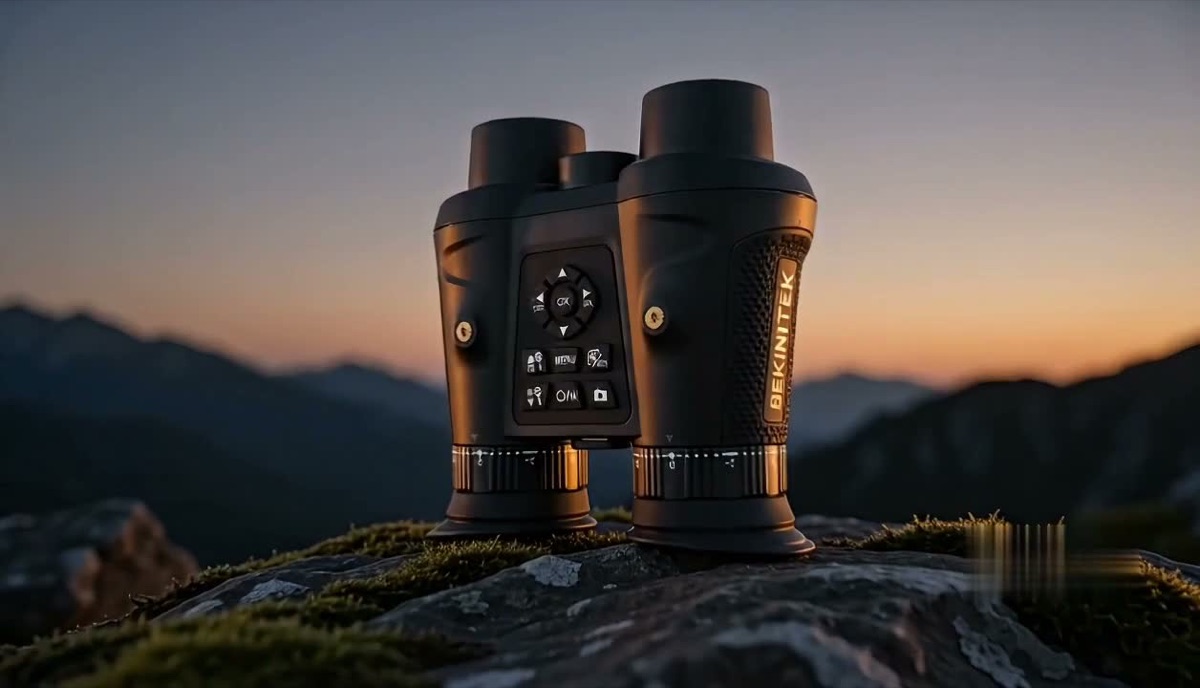
The NV-LG67 handheld 4K binocular viewer gives you seven IR steps and a 3-inch display, which is the unit we reach for in mist because you can fine-tune brightness one level at a time instead of jumping between low and high. In rain, the display also means you're not pressing your eye against a wet eyepiece.
The NV-DT59 5000mAh binocular is the one we suggest for long wet sessions. The bigger pack matters more than the spec sheet suggests, because cold and moisture both eat runtime. Pair it with a dry cloth and a planned 40-minute rotation rather than a four-hour marathon.
The NV600PRO binocular has 5x optical magnification, which sounds like an advantage until you're in fog. Higher magnification magnifies the veil too. If your property is misty, use its base view and skip the digital zoom; if you're in dry high desert, the reach is genuinely useful.
One more practical note: all three record. Footage from a foggy night looks worse on a laptop than it did in the eyepiece, because the sensor is already stretching a low-contrast scene and compression throws away what's left. Judge the image live, not from the file.
FAQ
Q: Can digital night vision see through fog at all? A: It sees into fog, not through it. In light haze you keep most of your range; in ground mist expect usable distance to drop to roughly 40–50 yards, and dense fog will stop you at 30.
Q: Should I turn the IR up to maximum in rain or mist? A: No. Maximum IR lights up the water in the air between you and the subject and produces a white veil. Drop one or two levels, let your eye adapt, and move closer instead.
Q: Why does the image go blurry in rain even when the rain is light? A: Water on the objective lens sits closer to the sensor than your subject and defocuses part of the frame. Wipe the front glass with a microfiber cloth; the blur usually clears instantly.
Q: Does fog damage the unit? A: No, but moisture does over time. These units are splash-resistant at best, not waterproof. Dry them before storage and don't leave them in a damp bag overnight.
Q: Is thermal better for foggy nights? A: For pure fog penetration, yes, because thermal reads heat instead of reflected IR light. It costs considerably more and shows less detail. If fog is occasional, a digital unit plus the three adjustments above is the better value.
What to do tonight
If mist is in the forecast, don't cancel the session. Set the IR two steps lower than usual, pick a viewing spot 30 to 40 yards from the fence line you care about, wipe the objectives, and give the unit ten minutes outside to equalize. You'll get a usable image instead of a white screen, and you'll stop blaming the hardware for weather it never claimed to beat.
If you're still deciding what to buy, start with our honest 2026 budget guide and then check the real tested ranges so your expectations match the air you actually observe in.