Your Ultimate 2026 BekinTek Buying Guide: Navigating the World of Night Vision and Outdoor Essentials
If you're reading this, chances are you've felt that familiar frustration: the sun dips below the horizon, and suddenly, your world shrinks. Whether you're a dedicated hunter, a wildlife enthusiast, a security professional, or just someone who loves exploring the great outdoors after dark, the inability to see clearly can be a real barrier. That's where BekinTek night vision comes in. We've spent years refining our digital night vision technology, and in 2026, our lineup is stronger and more versatile than ever.
This isn't just a catalog; it's a practical guide built from years of customer feedback, field tests, and countless hours spent under the stars. We're going to cut through the jargon and help you understand what truly matters when picking out your next piece of gear. From our robust helmet-mounted series to powerful night-vision binoculars and compact night-vision monoculars, we'll help you find the perfect fit. This guide was last updated in October 2026.
 18
18
Why Digital Night Vision is Your Best Bet in 2026
Gone are the days when night vision meant bulky, fragile, and prohibitively expensive analog tubes. Modern digital night vision, like what you'll find across the BekinTek range, offers incredible advantages. For starters, it's generally more durable, less susceptible to bright light damage, and often comes packed with features like video recording, photo capture, and even Wi-Fi connectivity.
We've seen a huge leap in sensor technology over the last few years. Our latest devices can deliver surprisingly crisp, full-color images in low light conditions, transitioning seamlessly to monochrome in near-total darkness when the IR illuminator kicks in. This versatility means you're not just getting a "night-only" device; you're getting a powerful tool that extends your vision from dusk till dawn.
Understanding Your Options: Monoculars, Binoculars, and Helmet-Mounted Devices
Choosing the right form factor is often the first big decision. Each has its strengths, and what works for one person might not be ideal for another.
Night Vision Monoculars: When Portability and Simplicity Matter
Monoculars are single-eye devices, designed for quick observation and maximum portability. They're lightweight, easy to stash in a pocket, and perfect for situations where you need to quickly scan an area or identify a target without drawing attention.
- Who it's for: Hikers, casual wildlife observers, security personnel needing a compact spotter, or anyone who values a minimalist setup.
- BekinTek Recommendation: Our BekinTek NV-M200 is a fantastic entry point. It's got a 720p sensor, offers a clear view up to 150 yards with its built-in IR, and runs for about 6 hours on a single charge. We've had customers tell us they keep it in their glove box for unexpected roadside wildlife encounters. It won't read a license plate at 200 yards — that's not what this device is for — but it'll clearly show you if that rustle in the bushes is a deer or just a raccoon.
- Consideration: Using one eye for extended periods can cause eye strain for some people. If you plan on long observation sessions, you might prefer binoculars.
Night Vision Binoculars: The Immersive, Comfortable View
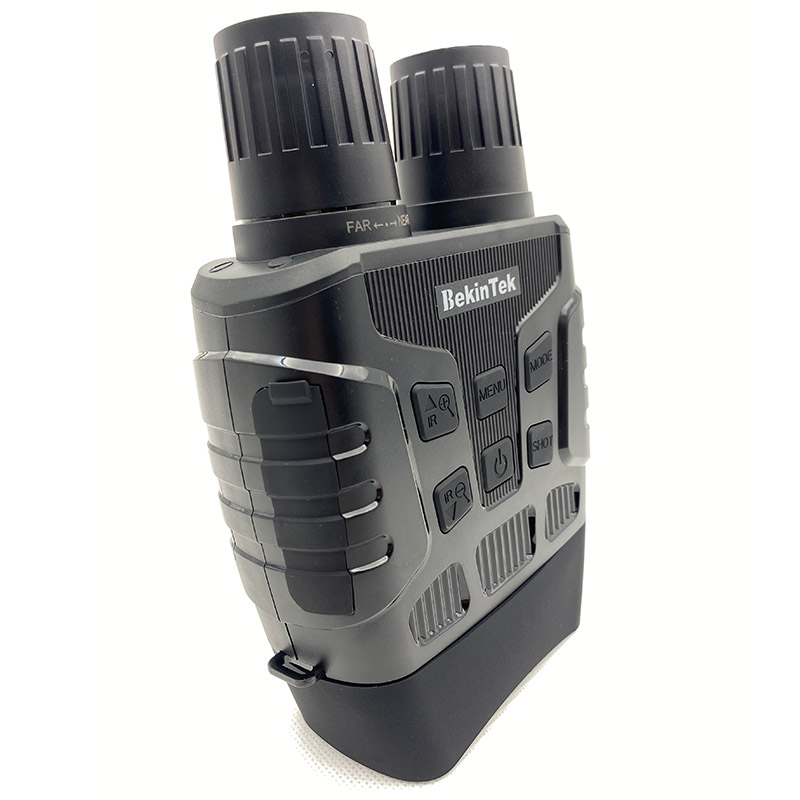
Binoculars offer a two-eye viewing experience, which is far more comfortable for prolonged observation and provides a greater sense of depth perception. They're generally larger and heavier than monoculars but offer superior stability and often house more powerful features.
- Who it's for: Serious wildlife observers, hunters tracking game, search and rescue teams, or anyone who needs to spend significant time scanning an area in the dark.
- BekinTek Recommendation: The BekinTek NV-B400 is our flagship binocular. It boasts a 1080p sensor, a detection range of up to 300 yards, and an impressive 8-hour battery life. We've tested this unit extensively in various conditions. On a 12°F night in November, we spotted a whitetail buck at roughly 120 yards using the NV-B400, clearly identifying its rack even through light snowfall. The dual-eye view makes a huge difference when you're trying to follow movement.
- Consideration: While great for observation, they're not ideal for hands-free operation unless mounted on a tripod.
Helmet-Mounted Series: Hands-Free Freedom for Dynamic Situations
For those who need to keep their hands free for other tasks – navigating, operating equipment, or holding a firearm – our helmet-mounted series is indispensable. These devices are designed to be lightweight and provide a stable, consistent view.
- Who it's for: Tactical users, airsoft enthusiasts, search and rescue personnel, or anyone needing to move through challenging terrain in the dark while maintaining situational awareness.
- BekinTek Recommendation: Our BekinTek NV-H500 is a top-tier choice for helmet mounting. It features a wide field of view, a robust housing, and a quick-release mount. We've designed it to be balanced and comfortable for extended wear. Customers often ask us about the field of view on these, and we can confidently say the NV-H500 offers a generous 40-degree FOV, which is crucial for maintaining peripheral vision when you're on the move.
- Consideration: These are specialized tools. If you don't need hands-free capability, a monocular or binocular might offer better value for pure observation.
Key Specifications You Can't Ignore (and What They Really Mean)
When you're looking at product pages, you'll see a lot of numbers. Let's break down what those specs actually translate to in the field.
Sensor Resolution & Image Quality: What You'll Actually See
This is probably the most crucial spec for image clarity. It's usually expressed in pixels, like 720p (1280x720) or 1080p (1920x1080).
- What it means: Higher resolution means more detail. A 1080p sensor will give you a sharper, clearer image, especially when you zoom in digitally.
- Our take: We often get questions about the difference between our 720p and 1080p sensors. While 1080p offers a noticeable bump in detail, especially when zooming, for basic observation at under 100 yards, the 720p on our NV-M200 is perfectly adequate and saves you a bit of cash. If you're trying to identify fine details on an animal at 200+ yards, or if you plan on recording video for later review, investing in a 1080p model like the NV-B400 is absolutely worth it.
Detection & Recognition Range: How Far is "Far Enough"?
These two terms are often confused, but they're distinct and important.
- Detection Range: The maximum distance at which you can detect the presence of an object (e.g., "there's something out there").
- Recognition Range: The maximum distance at which you can recognize what that object is (e.g., "that's a deer," or "that's a person").
- Our take: Our BekinTek NV-B400, for instance, has a stated detection range of 300 yards. In our experience, under ideal conditions (clear night, no fog, full moon), you can definitely spot a human-sized target at that distance. However, to recognize that it's a person and not just a bush, you're looking at closer to 150-200 yards. Always factor in environmental conditions – fog, rain, and even heavy tree cover will reduce these ranges significantly. Don't fall for exaggerated claims; real-world performance is what counts.
IR Illuminators: Your Secret Weapon in Total Darkness
Digital night vision needs some light to work. When there's no ambient light (like a moonless, cloudy night), the built-in Infrared (IR) illuminator becomes essential.
- What it means: The IR illuminator emits invisible infrared light, which the night vision device "sees" and converts into a visible image. More powerful IR means you can see further in absolute darkness.
- Our take: All BekinTek night vision devices come with integrated IR illuminators. Our NV-DT79, for example, has a powerful 850nm IR emitter that can illuminate targets up to 250 yards away in pitch black. We advise customers to think of the IR as a flashlight only you can see. It's crucial for those truly dark nights. Some models even allow you to adjust the IR intensity, which is handy for avoiding "washing out" closer objects.
Battery Life & Power Solutions: Don't Get Caught Short
There's nothing worse than your gear dying in the middle of an important observation.
- What it means: How long the device will run on a single charge or set of batteries.
- Our take: We design our devices for practical field use. Our NV-B400 offers up to 8 hours of continuous use, which is usually enough for a full night out. Many of our models, including the NV-M200, also support external power banks via USB-C. We always recommend carrying a spare set of batteries or a fully charged power bank, especially if you're going to be recording a lot of video, as that drains power faster. A common misconception is that turning off the screen saves a ton of power; while it helps, the sensor and IR are the main power consumers.
Durability & Weatherproofing: Built for the Wild
Outdoor gear needs to withstand the elements.
- What it means: How resistant the device is to impacts, dust, and water. Look for IP ratings (e.g., IPX4, IP67).
- Our take: All BekinTek products are built tough. Our NV-DT79, for example, features a rugged, rubber-armored housing and an IPX4 water resistance rating, meaning it can handle splashes and light rain without issue. We've had customers accidentally drop these from chest height onto hard ground, and they've kept working. While they're not designed for submersion, they're definitely built to handle the bumps and scrapes of real outdoor use.
Beyond Night Vision: Other BekinTek Outdoor Essentials
While night vision is our core expertise, we also offer a range of other outdoor essentials designed to complement your adventures. These aren't just add-ons; they're built with the same commitment to quality and utility.
For instance, our BekinTek Digital Photo Frame might seem out of place, but many of our customers use it to display the incredible wildlife photos and videos they capture with their night vision devices. It's a fantastic way to relive those moments. We also carry robust Sport Cameras that are perfect for capturing daylight action, and durable Water Purifiers for those extended trips where clean water is paramount. We believe in equipping you for every aspect of your outdoor journey.
Making Your Choice: Real-World Scenarios
Let's put it all together with some common use cases.
For the Hunter: Spotting Game Before Dawn or After Dusk
You need reliable detection and recognition, often at varying distances.
- Our advice: For stationary observation from a blind or stand, the BekinTek NV-B400 binoculars are hard to beat for comfort and clarity. If you're stalking or moving through dense brush, a compact NV-M200 monocular might be more practical for quick scans. Consider a model with good digital zoom to help identify antlers or specific features.
For the Wildlife Observer: Detailed Views Without Disturbing Nature
You're looking for clear, detailed images, often for extended periods, and potentially for recording.
- Our advice: The BekinTek NV-B400 is ideal here. Its 1080p sensor and comfortable dual-eye viewing make it perfect for watching nocturnal animals. The ability to record video and capture photos means you won't miss a moment. We've had customers use these to observe everything from owls to coyotes, even documenting rare species.
For Security/Surveillance: Keeping an Eye on Your Property
You need reliable detection, often with the ability to record evidence.
- Our advice: A BekinTek NV-M200 monocular is great for patrols or quick checks. For fixed-point surveillance, especially if you need hands-free operation or a wider field of view, our NV-H500 helmet-mounted device (perhaps tripod-mounted) can be incredibly effective. Look for models with good IR range and robust video recording capabilities.
BekinTek's Promise: Why Choose Us
We know there are a lot of options out there, but we stand by our products and our commitment to our customers. When you choose BekinTek, you're not just getting a piece of gear; you're getting peace of mind. We offer Free Shipping on all orders, a no-hassle 14-Day Returns policy, and a comprehensive 5-Year Warranty on all our night vision devices. We're confident you'll love your BekinTek gear, but if something isn't right, we'll make it right.
We hope this guide has cleared up some of the complexities of choosing night vision and other outdoor essentials. The right gear can truly transform your outdoor experiences, opening up a whole new world after dark. If you have more questions, don't hesitate to reach out to our expert team. We're always happy to help you find your perfect match.
FAQ
Q1: Can BekinTek night vision devices see in complete darkness?
A: Yes, absolutely! All BekinTek digital night vision devices come with a built-in Infrared (IR) illuminator. When there's no ambient light (like on a moonless, cloudy night), the IR kicks in, emitting invisible light that the device's sensor picks up, allowing you to see clearly in pitch black conditions. Our NV-DT79, for example, can illuminate targets up to 250 yards away in total darkness.
Q2: What's the real difference between a night vision monocular and binoculars?
A: The main difference is comfort and depth perception. Monoculars (single-eye, like our NV-M200) are lighter, more compact, and great for quick scans or when portability is key. Binoculars (two-eye, like our NV-B400) offer a more natural, immersive viewing experience, reduce eye strain during long observation periods, and often provide better depth perception, which is crucial for tracking moving objects.
Q3: Are BekinTek night vision devices waterproof? Can I use them in the rain?
A: Our devices are built to withstand typical outdoor conditions. For example, our NV-DT79 has an IPX4 water resistance rating, meaning it's protected against splashes and light rain. While they're not designed for submersion, you can certainly use them in light to moderate rain without worry. We always recommend checking the specific IP rating for the model you're interested in.
Q4: How long does the battery last on your night vision devices?
A: Battery life varies by model and usage. Our BekinTek NV-B400 binoculars offer up to 8 hours of continuous operation, which is usually enough for a full night out. Factors like heavy IR use, constant video recording, and digital zoom will consume power faster. Many of our devices also support external power banks via USB-C, so you can extend your time in the field.
Q5: Can I record videos and take photos with BekinTek night vision?
A: Yes, most of our latest BekinTek night vision devices, including the NV-M200 and NV-B400, feature built-in video recording and photo capture capabilities. They typically store files on a microSD card (sold separately or included with some bundles). This is fantastic for documenting wildlife, security incidents, or just reliving your outdoor adventures later.
Q6: What's the best BekinTek night vision device for hunting?
A: For hunting, we generally recommend our BekinTek NV-B400 night vision binoculars (NV-B400). Its 1080p sensor provides excellent clarity for identifying game, and the dual-eye viewing is much more comfortable for extended periods of scanning. The 300-yard detection range and powerful IR illuminator ensure you won't miss anything in low light or total darkness. For a more compact option for stalking, the BekinTek NV-M200 monocular (NV-M200) is also a strong contender.